A big win for a broad coalition, a bad day for big grocery chains and Big Tech!
Seattle City Council votes 7-2 to ban surveillance pricing for groceries -- the first city in the country with a ban!

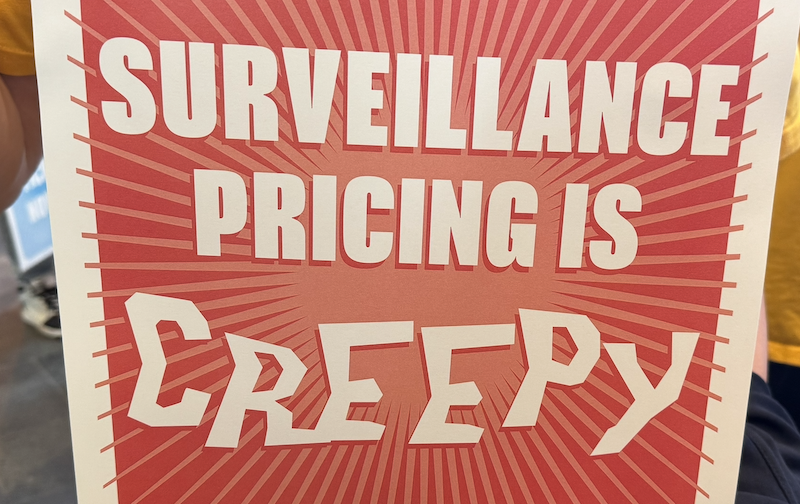
"Mayor Katie B. Wilson and City Councilmember Alexis Mercedes Rinck are committed to protecting people’s privacy and making sure grocery prices are fair, transparent, and affordable. And today, with co-sponsors Councilmembers Dionne Foster and Rob Saka, the Full Council approved the Fair and Transparent Pricing policy, a first‑in‑the‑nation city-led consumer protection measure designed to stop grocery retailers from using personal data to set different prices for different customers."
– Seattle Becomes First City to Stop Grocery Stores from Using AI Based Personal Data to Set Prices, Alex Hudson, seattle.gov
Huzzah!
After close to 90 minutes of outstanding public comments from consumers, workers, faith leaders, privacy experts, social justice and human rights groups all supporting the audience (and a dozen lobbyists repeating industry talking points), followed by another two hours of swatting down a stream of amendments from Councilmember Bob Kettle that would have added loopholes undermining the bill's protections and weakening enforcement, the room exploded into cheers when the council voted 7-2 to pass the bill.
(And if you think that was a long sentence, just try to imagine how long the hearing was. My live-skeeting thread has a lot of the details, along with some snark; I'll post the video once it's available.)
As Councilmember Foster said before the final vote, when others don't take action to protect people, it's up to municipalities to act, and Seattle's City Council showed a lot of leadership here. Not only is Seattle the first city to pass a ban on surveillance pricing, it's one of the few surveillance pricing bans to include a private right of action, and its protections are a lot stronger than the bills that Maryland and Connecticut passed.
So it's a big big win for the broad coalition that's supported this ordinance – as Seattle grocery store worker Kristen Wilder told Common Dreams, it feels historic.
and a big loss for the big grocery chains and Big Tech companies that profit by exploiting people's personal data. Congrats and kudos to Councilmembers Rinck, Foster and Saka, and everybody in the very broad coalition that shaped and supported this bill!
I'll return to the kudos and congratulations at the end of this post, but first some thoughts on the vote and what might happen next.
- Most of Seattle's Concilmembers saw through the nonsense
- What's industry's next move?
- An apology to Council Prsendent Hollingsworth
- Will big grocery chains end their loyalty programs in Seattle?
- This huge win will build momentum across the country
- Congratulations and kudos to everybody involved!
Most of Seattle's Concilmembers saw through the nonsense
One big reason the ordinance provides stronger protections than other similar bills is that the Mayor's office pulled did a lot of work with stakeholders to craft a very good ordinance – and get independent grocers on board, which defused potential opposition by making the widely-loathed big grocery chains be the public face of the opposition. Another equally-important reasons is that despite Kettle's best efforts, Seattle's ordinance avoided a key loophole that industry had spent the last six weeks pushing here with a mass-texting disinfo campaign.
Using personal data to give discounts (as two of Kettle's amendments proposed) is just another way of implementing surveillance pricing. If they're using personal info to charge you $9 for the same item they're only charging me $7 for, they're using personal info to charge you more even if they set list price to $10 and claim we're both getting "discounts."
Fortunately, most of Seattle's Councilmembers saw through this nonsense; only Councilmember Maritza Rivera joined Kettle in voting for it. Yay! It's especially impressive because industry has gotten that exact same loophole into several other states' surveillance pricing bills, including Maryland's and Connecticut's, And when I was browsing Bluesky a few hours after the vote, I saw a post from Portland City Councilor Angelita Morillo lamenting that their City Life Committee had just passed a very similar amendment!
So, well done by the 7/9 of the Seattle Council who got it! Hopefully we can figure out a way to get other city councils to understand this.
What's industry's next move?
Of course, big grocery chains and their Big Tech partners aren't going to just give up after one bad day. They've almost certainly already started to look for new ways to use surveillance technologies try to weasel around the bill's prohibitions.
It's not going to be easy to prove a company has engaged in surveillance pricing; even after being caught red-handed charging people different prices in the landmark study by Goundwork Collaborative, More Perfect Union, and Consumer Reports, industry continues to claim it was just "randomized testing". The civil penalties in the private right of action are capped at $1 million for any class action suits – pocket change for companies like Kroger, which makes hundreds of millions a year of profit just from monetizing customer data. So while they'll probably avoid blatantly breaking the law, they're likely to try to test its limits. Several failed amendments point to different paths they might take: finding ways to use coupons and purchase history; using new technologies like smart shopping cards as a way to prices; and laundering personal data through various backdoors to make it even harder to prove violations.
In my written comments, I talked about what an example of a backdoor and barrier to enforcement in one of the amendments that passed. The amendment responded to concerns about retail theft by allowing surveillance technologies to be used for loss prevention, fraud detection, and fraud prevention as long as the data wasn't used "directly or indirectly" for algorithmic price-based discrimination. I certainly understand the goal of not undercutting attempts to reduce retail theft, but lobbyists are very good at exploiting legislators' good intent by suggesting sneaky wording that seems innocuous but hides loopholes, and it seems to me that may have happened here:
"For example, when Palantir uses "deidentified" (haha) data from fraud prevention to train their AI models which also power their Holistic Pricing Optimization product, industry can argue that it's not "direct or indirect" sharing."
It's especially disappointing that the "loss prevention" amendment passed because its language aligns with the odious CORCA bill currently pending in Congress that would expand DHS's surveillance powers by creating a public-private partnership.
But retail theft at grocery stores is a big issue in Seattle so I wasn't surprised that the amendment passed. At the end of the day, there's only so much you can do.
As Councilmember Saka said in his closing remarks, no legislation is perfect Sure, I would have liked a private right of action with no limits on civil penalties ... but there is no way that would have gotten through the Council, so I didn't even propose it. Overall it's still a very strong bill, and we'll just have to react to whatever tricks industry has up their sleeves.
An apology to Council President Hollingsworth
Returning briefly to the topic of the loss prevention amendment, I want to apologize to Council President Joy Hollingsworth, who made it clear that she was hurt by people questioning her intent in bringing it.
I absolutely don't doubt her intent here at all. I'm sure she brought this amendment to address the very real problem of retail theft at grocery stores, and I should have been much clearer about that. And, I also should have been clearer that I very much appreciate the job she did as Council President to help the sponsors steer a very controversial bill through despite the intense lobbying against it.
So, my apologies for the disrespect.
Will big grocery chains end their loyalty programs in Seattle?
After weeks of threats of "unintended consequences," Safeway finally made it explicit the day before the vote, saying they'll end their loyalty program in Seattle if the ordinance passes. As I said in A golden opportunity in Seattle.
"Oh please. The ordinance explicitly allows loyalty programs (as well as discounts and coupons). And loyalty programs were around for decades before surveillance pricing even existed, so they can certainly continue to offer them if they want to. Either they're bluffing, or they're admitting that exploiting consumers with surveillance pricing is so profitable that they're willing to sacrifice the millions of dollars a year they get from monetizing the data of loyalty program members in Seattle. We'll see how effective it is politically, but it's certainly not a particularly persuasive argument."
We won't know for a while whether they're bluffing – the ban on surveillance pricing doesn't take effect until September 2027 – but it wouldn't surprise me if they do actually follow through, and Kroger's (who owns QFC and Fred Mayer) might well join them. They're both going to continue to raise prices everywhere no matter what, but they're probably happy to have an excuse to raise prices even more in Seattle. My guess is that the mass texting campaign, and all the talk about affordability from CM's Kettle and Rivera in their statements today, are all laying laying the groundwork for a potential multi-pronged campaign:
- Try to blame all their price increases here on the ordinance and the Councilmembers who voted for it.
- Try to make it a campaign issue for the 2027 city council elections in Seattle.
- Depending on how quickly they decide to do it, they could even try to paint higher grocery costs in Seattle as a cautionary tale as they lobby for weak legislation cities and states around the country, the 2027 legislative session here in Washington, and in Congress
Like I say, we'll see how effective it is politically. Industry-friendly media outlets (like the Seattle Times, for example) will certainly help spread this message ... but I don't know how many people will get fooled. Time will tell.
This huge win will build momentum across the country
"We've all seen the headlines about the risks of AI and need for regulation.. You have a golden opportunity to do something concrete today to protect Seattle consumers, workers, and independent grocers – and be a model for other cities and states considering similar bans"
– me, in my public comment
“AI harms are generally privacy and surveillance harms. AI needs data in order to work. Mass commercial data surveillance is the reason we have AI and vice versa, and that is an infinite loop.”
– Maya Morales of WA People's Privacy, quoted in Olivia Rosane's ‘Historic’: Seattle Passes First City Ban on AI-Enabled Surveillance Pricing on Common Dreams
More positively, though, this huge win will help organizers in other cities and states across the state and across the country. Industry had killed a surveillance pricing bill in California just a couple of weeks ago, and they've stalled New York's surveillance pricing bill for months ... but guess what, they're not invincible! And as well as the strong legislation providing a a model of what's possible, the Seattle coalition's very successful tactics can hopefully be adapted by organizers elsewhere to reflect the dynamics wherever they are.
It's an especially timely win both because of the broad focus on AI regulation, and because Lindsay Owens of Groundwork's book Gouged: The End of a Fair Price – and What That Means for Your Wallet is coming out next week. Gouged already getting some great press; check out Owens' 90-minute segment with Jon Stewart on Algorithmic Price Manipulation & Targeted Gouging. So I expect we'll be hearing a lot more about this. The wins against surveillance pricing for groceries are just a starting point. Other industries relying on these kinds of exploitative practices should be very nervous as well.
And as Seattle Councilmember Eddie Lin pointed out in his excellent closing remarks, the opposition to surveillance pricing is bipartisan. So is the resistance to data centers, and the wave of organizing against Flock and other AI-enabled ALPR surveillance cameras. There are clearly a lot of synergies here!
Speaking of which,
- The Washington State Day of Action on Data Centers is October 4, organized by .Washington AI Resistance, Food & Water Watch, Seattle DSA, Troublemakers Community, Oil & Gas Action Network (OGAN), and People's tech Project. Here's a list of events across the state – and the page also has links to virtual office hours if you want help some help setting up your own event
- And if you're in King County, Tell King County Council: Pass a Data Center Moratorium Now!
Congratulations and kudos to everybody involved!
In her closing remarks today, Councilmember Rinck (frequently referred to as AMR) highlighted the contributions of UFCW 3000, WA People's Privacy, MLK Labor, Transit Riders Union, staffers in the Mayor's office as well as her own organization, and a host of others ... agreed, and AMR deserves a huge amount of credit too! And on top of that, dozens of consumers and grocery workers gave public comment, well over a hundred people attended the variou hearings, and literally thousands contacted the councilmembers.
But l'm going to wrap this post up with the much longer list of organizations who AMR listed in her closing remarks at the previous committee vote – all of whom provided public comment on the bill, and encouraged consumers and workers to contact their council members.
- Washington People's Privacy,
- ACLU of Washington
- The Nexus Of Privacy
- Consumer Reports
- Tech Equity Action
- Transit Riders Union
- Washington Fair Trade Coalition
- Amazon Employees For Climate Justice
- APRI
- Seattle 350
- Seattle Queer Power Alliance
- Washington Working Families Party
- Food And Water Watch
- Lavender Rights Project
- Washington AI Resistance,
- IAM 7551, People Power
- Washington Solidarity Budget
- Communities Not Cameras
- Stop Surveillance City
- Be Seattle
- Seattle Indivisible
- Working Washington
- Faith Action Network
- SRIA 775
- Queen Anne Baptist Church
- Faith Action Networ
- One America
- Woodland Park Presbyterian Church,
- The Church Council Of Greater Seattle
- MLK Labor
It really is a remarkably broad coalition.
Congratulations and kudos to everybody involved!